
What is Service Mapping, and why does it matter to enterprises?
Updated: Sep 16

Author:
Matt Austin
Client Portfolio Lead
Most organisations can list their applications and servers. Far fewer can answer a harder question: if this business service goes down, exactly what breaks, in what order, and what does it take to bring it back? Service mapping is how you answer that question - and, increasingly, how regulators expect you to prove you can.
It is tempting to treat mapping as a compliance chore. We see it differently. The regulatory pressure now bearing down on operational resilience is, in practice, a forcing function for something most enterprises have wanted for years: a genuine, current understanding of how their technology estate actually delivers the business.
Done well, service mapping does not just satisfy a regulator - it speeds up recovery, de-risks change, and lays the groundwork for automation. This article explains what service mapping is, how it differs from service recovery mapping, why it matters commercially and to regulators, and how to approach it as an opportunity rather than a burden.
Contents
Key facts at a glance
What it is: service mapping connects each business service to the people, processes, applications, infrastructure and third parties that deliver it - a living dependency model rather than a static inventory.
Why it matters: you can only isolate, protect and recover what you understand. Accurate maps reveal critical paths and single points of failure, enabling faster, more confident incident response and change.
The regulatory driver: UK firms had until 31 March 2025 to show they can stay within impact tolerances for important business services - which requires mapping. The EU’s DORA, in force since January 2025, sets parallel expectations. [1] [2] [4]
Static vs dynamic: regulators are technology-neutral, but they expect mapping to be detailed, current and able to surface vulnerabilities. Paper-based maps can meet the regulations once, but are rapidly outdated and struggle to prove ongoing resilience. [1]
The opportunity: the effort of mapping pays back well beyond compliance - in resilience, faster recovery, reduced change risk, and a foundation for observability and automation.
What is service mapping?
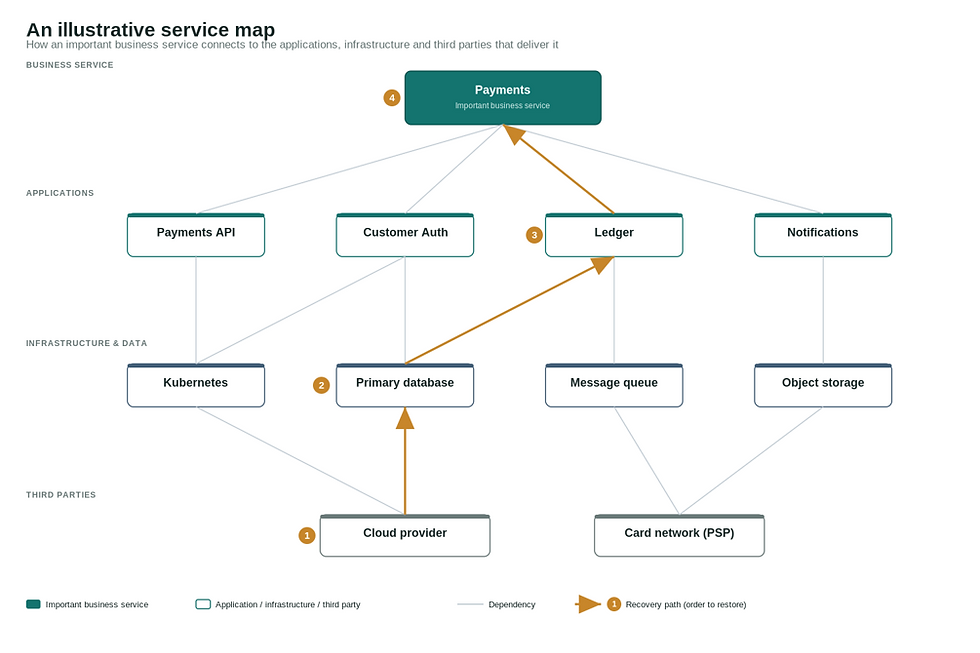
Service mapping is the discipline of connecting a business service - the thing a customer or the business actually relies on, such as “process a payment” or “open an account” - to everything required to deliver it: the applications, infrastructure, data, people, processes and third parties beneath it, and the dependencies between them.
The distinction that matters is between an inventory and a model. A configuration management database (CMDB) or asset register tells you what you have. A service map tells you how those components combine to deliver a service, and what happens to that service if any one component fails. In tooling terms it is often described as a “top-down” approach that maps business services down to the underlying configuration items, turning a technical inventory into a business-aware view of dependencies. [5]
Mature service mapping is dynamic rather than documentary. A diagram drawn once in a workshop is out of date the moment the next change ships. The goal is a living model - ideally built and refreshed from real data about how services actually run - that identifies critical paths, single points of failure and recovery priorities, and stays current as the estate evolves.
At Automiq we think of this as building a knowledge graph of the estate: business services mapped to applications and infrastructure, accurate enough to isolate incidents and recover quickly.
What is the difference between service mapping and service recovery mapping?
These two terms are often used interchangeably, but they answer different questions - and enterprises need both:

Service mapping explains how a service works. It shows how the service is delivered day to day: the people, processes, technologies and dependencies involved in normal, business-as-usual operation. It is the foundation - the picture of how everything connects.

Service recovery mapping explains how a service is recovered when it doesn’t work. It focuses on what happens when the service is disrupted: the recovery processes, responsibilities, sequencing and dependencies needed to restore the service quickly and in a controlled order.
Put simply: service mapping explains how a service works, while service recovery mapping explains how it is recovered when it doesn’t. A service map tells you the lights are connected; a service recovery map tells you which switch to throw first, and who throws it, when the building goes dark. Regulators care about both - understanding your important business services, and being able to demonstrate you can recover them within your impact tolerances.
Why does service mapping matter?
The practical value shows up long before a regulator asks.
When an incident hits, the difference between a contained outage and a prolonged one is usually understanding. If you can see how a service is constructed and which dependencies sit on its critical path, you can isolate the problem, communicate impact accurately, and recover in a sensible order. Without that view, incidents are managed in isolation, with limited sight of upstream and downstream impact - which is precisely what turns a short outage into a long one, especially in complex, globally-distributed estates.
Mapping also de-risks change. Most major incidents are triggered by a change, the blast radius of which was not understood. A current service map lets you assess what a change will actually touch before you make it. It surfaces single points of failure that warrant investment, supports cloud migration and modernisation by revealing what truly depends on what, and underpins cyber resilience - you cannot contain or recover from an attack you cannot map, a problem made sharper by the rise of AI-enabled threats that move at machine speed.
A comprehensive understanding of the technology estate and its interdependencies is also the bedrock of meaningful observability and automation: you cannot automate a response, or trust a dashboard, without an accurate model of the service underneath.
How does service mapping support regulatory compliance?

Operational resilience regulation has turned service mapping from good practice into an expectation, across both the UK and the EU.
In the UK, the FCA’s operational resilience rules (Policy Statement PS21/3, embedded in SYSC 15A of the Handbook) and the PRA’s Supervisory Statement SS1/21 require in-scope firms to identify their important business services, set impact tolerances, and map the resources - the people, processes, technology, facilities and information - needed to deliver each service to a level of detail that lets them identify vulnerabilities and remain within those tolerances. The transition period ended on 31 March 2025: by that date firms had to have completed mapping and testing so they could remain within impact tolerances for each important business service. “Mapping resources” is one of the areas the FCA actively assesses in firms’ self-assessments. [1] [2]
In the EU, the Digital Operational Resilience Act (DORA), in force since 17 January 2025, sets parallel expectations. Its ICT risk-management requirements oblige financial entities to identify, classify and document the business functions, roles, information assets and ICT assets that support them, and to map their configurations and interdependencies - service mapping by another name. DORA also requires firms to maintain a “register of information” of their ICT third-party arrangements.
Alongside these, the UK’s Critical Third Parties regime - introduced jointly by the Bank of England, PRA and FCA and applying from 1 January 2025 - brings systemically important suppliers, such as major cloud providers, into the regulators’ oversight, reflecting how much resilience now depends on understanding third-party dependencies. [4] [3]
The common thread is dependency. Whether the label is “important business services”, “critical or important functions” or “critical third parties”, regulators are asking the same underlying question: do you understand what your critical services depend on, and can you keep them running - or recover them - when something fails? Service mapping is how you evidence the answer.
Are paper-based service maps sufficient for regulators?
This is one of the most common - and most consequential - questions we are asked. The honest answer is: sometimes, briefly, but rarely for long.
Regulators are technology-neutral. Neither the FCA, the PRA nor DORA mandates a particular tool, and there is no rule that says a map must be automated. A well-constructed document or spreadsheet can satisfy the letter of the requirement at a point in time. So in the narrow sense, yes - a paper-based map can be “sufficient” the day it is signed off.
The problem is that resilience is not a point in time. As the FCA put it in its 2026 review, operational resilience “is not static” and firms should take “a dynamic approach including regularly reviewing” their measures. A static map ages the moment a change is made to the environment, and within months it quietly diverges from reality. A map that no longer reflects the estate cannot reliably identify vulnerabilities, support a real incident, or evidence ongoing compliance in the next annual self-assessment. Maintaining a large paper map by hand is also labour-intensive and error-prone - effort that competes with the very remediation it is supposed to inform. [1]
The honest truth: paper-based maps can get you over an initial line, but they do not support sustained resilience. The direction of travel - and the more defensible posture with a regulator - is towards dynamic service maps that are built from, and kept current by, real operational data, embedded in business-as-usual processes so they stay accurate rather than becoming shelfware.
What are the common challenges?
Service mapping is worth doing, but it is fair to acknowledge why it is hard - and where programmes go wrong.
Scope definition: Trying to map everything at once produces sprawl, cost and maps no one maintains. the firms that succeed start with their most critical business services and extend deliberately.
Accuracy and currency: an automated map is only as good as the data feeding it, and a manual one is only as good as the last person who updated it.
Ownership and accountability: maps decay without clear accountability for keeping them current, and without being wired into change and incident processes so they update as a by-product of normal work.
Technological complexity: enterprises typically have complex, hybrid estates with a plethora of technologies in use. The majority of service management platform developers who are able to configure service maps are ill-equipped to navigate the breadth of technical conversations required with infrastructure and application owners.
At Automiq, we have a service mapping methodology - proven in global enterprise clients - that addresses these challenges head-on. Our approach ensures the creation of accurate, sustainable service maps that are embedded into BAU and support regulatory compliance.
Why is this an opportunity, not just a compliance burden?
The work a regulator is effectively compelling - understanding your important business services and what they depend on - is work that pays for itself many times over.
The FCA is explicit that this is not merely cost. Investing in operational resilience, it notes, “helps drive long-term growth”, with resilient firms “better positioned to innovate, attract customers, and support market confidence”, and it encourages firms to “move beyond compliance” and treat resilience as a core business capability.
That is exactly our experience. The estate knowledge built for a resilience programme is the same knowledge that lets you retire technical debt with confidence, migrate to cloud without nasty surprises, target observability where it matters most, and automate incident response safely.
For years the business case for mapping the estate has been hard to make on its own, however the regulatory deadline makes it fundable. The organisations that seize that, rather than doing the minimum to pass, come out understanding their business better and running it more efficiently. The compliance burden, handled well, becomes the catalyst for the modernisation. [1]
What enterprises should do now - and how Automiq can help
The first step is rarely the purchase of any new tooling - most firms already own service management platforms that are suitably capable of building service maps.
We help clients leverage that tooling to derive real operational value:
Build dynamic, usable service maps - not shelfware: Service Mapping for Operational Resilience & Rapid Recovery.
Leverage service mapping data to automate end-to-end vulnerability remediation processes: Vulnerability Operations (VulnOps) Automation.
Turn mapping into regulator-ready resilience: Modernising Operational Resilience Planning.
Map for recovery, not just understanding: Cyber Resilience & Recovery Planning.
Keep maps current by leveraging real data: Observability Implementation & Integration.
Make your platform do the heavy lifting: Service Automation Platform Optimisation & Modernisation.
Ensure service mapping processes are integrated with BAU: Service Process Design & Interoperability
Define an operating model that embeds ownership of service maps: Target Operating Model Design & Optimisation.
The bottom line
Service mapping has quietly become one of the highest-value activities an enterprise IT function can undertake.
It is the difference between managing an incident blind and resolving it in a controlled manner; between guessing at the impact of a change and knowing it; between drafting a compliance document and a developing a genuine understanding of how your business runs.
Regulation has made service mapping unavoidable - but the firms that treat it as an opportunity, not a box to tick, end up more resilient, more efficient, and better placed to automate.
Frequently asked questions
What is service mapping in simple terms?
Service mapping connects a business service - something the business or its customers rely on - to everything needed to deliver it: the applications, infrastructure, data, people, processes and third parties beneath it, and the dependencies between them. It turns a list of technical assets into a picture of how a service actually works.
How is service mapping different from a CMDB?
A CMDB or asset register tells you what you have; a service map tells you how those components combine to deliver a service and what fails if one breaks. Service mapping is typically a top-down view that sits on top of the configuration data and makes it business-aware. [5]
Is service mapping a regulatory requirement?
Effectively, yes, for in-scope financial firms. UK operational resilience rules (FCA PS21/3 and PRA SS1/21) require firms to map the resources behind their important business services, and the EU’s DORA sets parallel ICT mapping and third-party register expectations. Regulators don’t mandate a specific tool, but they expect mapping detailed and current enough to identify vulnerabilities and evidence resilience. [2] [4]
Are paper-based or spreadsheet service maps good enough?
They can satisfy the requirement at a single point in time, but they age quickly and are hard to maintain. Because the FCA expects a “dynamic approach”, maps built from real operational data and kept current are a far more defensible and useful basis for sustained resilience. [1]
Sources & further reading
[1] Financial Conduct Authority - Operational resilience: insights and observations one year on (2026)
[2] Financial Conduct Authority - Operational resilience (PS21/3; SYSC 15A; 31 March 2025 deadline)
[3] Bank of England / PRA / FCA - Critical Third Parties to the UK financial sector (PS16/24)
[4] European Banking Authority - Digital Operational Resilience Act (DORA) (in force 17 January 2025)
[5] ServiceNow - Service Mapping / Dependency Views (dynamic, top-down dependency maps)


